Governance
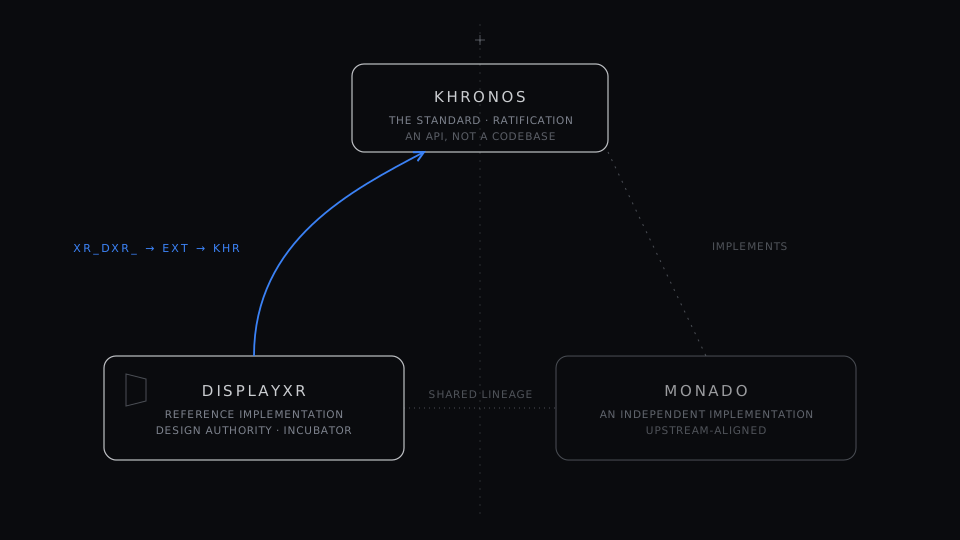
DisplayXR is an open incubator for spatial-display extensions to OpenXR, with the aim of upstreaming proven extensions into the official specification. The project is maintainer-led during incubation, with governance intended to broaden as adoption grows.
Project status
DisplayXR is in its incubation phase, stewarded by its founder and lead maintainer, David Fattal. During this phase, vendor neutrality rests on three structural guarantees:
Open by license
Extension specs, runtime, engine plugins, and demos are permissively licensed open source — the runtime is a Monado-derived codebase under the Boost Software License.
Neutral by architecture
Every display vendor integrates through the same documented plug-in boundary; no vendor has a privileged code path. The first such plug-in targets Leia-based displays — one implementation of that boundary among the many it is designed to support.
Decided in public
Design rationale is recorded as public Architecture Decision Records. Architectural decisions take effect when they're written down.
Stewardship & conflict of interest
We state the conflict directly rather than leave it to be inferred: DisplayXR's founder and lead maintainer, David Fattal, is also an employee of Leia Inc. — the vendor whose plug-in is the first integration of the plug-in boundary. Two commitments hold neutrality in place: Leia has no privileged position — no privileged code path (the runtime ships zero vendor identifiers, CI-asserted), no privileged review authority, and no reserved governance seat — and the project intends to move its identity (domain, organization, name, signing keys, reference builds) to a small independent steward outside any single vendor as adoption grows. Full detail in the governance document.
How an extension becomes part of the standard
The lifecycle is modeled on the OpenXR working group's own process. Extension identifiers are provisional until registered with Khronos through the official process.
- 1
Proposal
An issue or spec PR on displayxr-extensions: the problem, the API surface, and which display classes it serves.
- 2
Spec + implementation
No spec lands without a working implementation in a conformant runtime. Both are reviewed together — the OpenXR working group's own rule.
- 3
Experimental
Merged extensions ship in the runtime marked experimental; the API can still move in response to real-world use.
- 4
Stable
Once shipped applications depend on it and a full release cycle passes without breaking changes, the extension is frozen.
- 5
Upstream
Extensions proven across multiple vendors' hardware become candidates for the official Khronos OpenXR registry.
The path to shared governance
The transitions below describe the direction the project intends to take as adoption grows — a statement of intent for how governance will broaden, not binding commitments.
Today — incubation
currentMaintainer-led by a small core team. All design happens in public: specs, ADRs, issues, and PRs. Neutrality is enforced by architecture and license.
A second, independent vendor adopts the plug-in boundary
The project intends to form a Technical Steering Committee with representation from participating organizations alongside maintainer seats, and to move extension approval to that committee.
Extensions in production across multiple vendors' hardware
The project intends to pursue formal Khronos engagement — an exploratory-group proposal and/or submission of proven extensions to the OpenXR working group.
Khronos adoption
Specs migrate to the official OpenXR registry. The project intends to continue as the open reference implementation and the incubator for the next round of extensions.
How to participate
A second independent vendor plug-in is the milestone at which the project intends to move toward shared governance. Display vendors start with the plug-in guide; developers and contributors start at Contribute. No membership, fee, or affiliation required.
Read the full governance document